The typical Whitstable Oyster Yawl was between 40 and 45 foot in length. There were exceptions, for example the Rosa & ADA (F105) was 47 foot and Thyra was only 36 foot. For the yards along Island Way these were relatively small. Much larger craft were built on the slipways and then let down in to the sea at a time when there was no sea-wall.
If you are interested in learning more about the larger vessels, then the Merchant Ships of Whitstable by Wallace Harvey (Emprint Publications, 1993) is a good source.
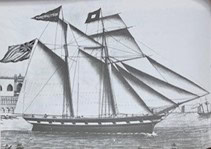
Some larger sailing ships registered as Whitstable built
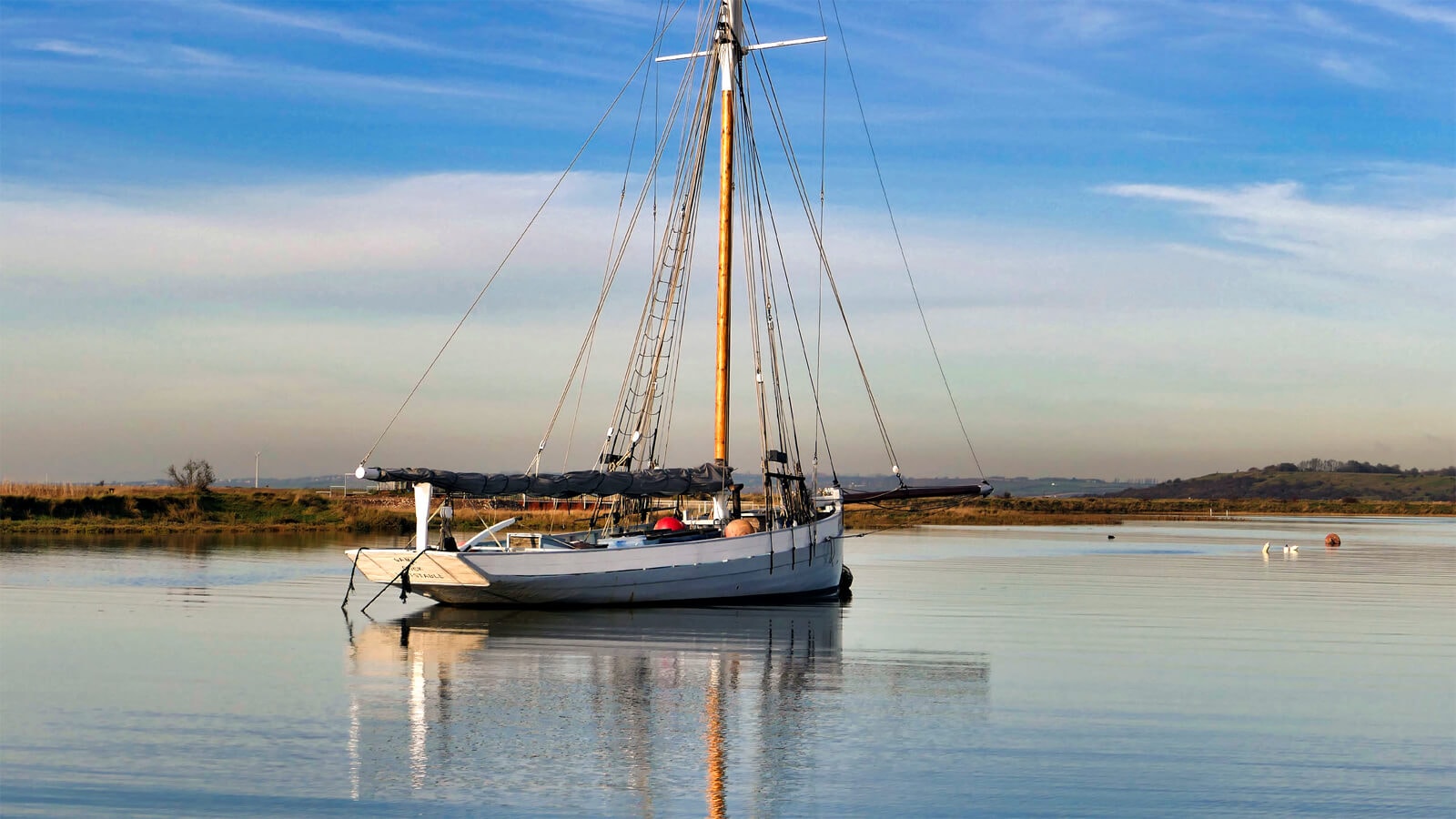
Gamecock is one of the finest examples of her type, but why build a boat dedicated to a single purpose – the dredging of oysters? The answer is money.
Gamecock is a graceful boat with curved lines running from bow to stern but her design is very functional. The hull is lacking in space because she rarely worked overnight. Her single keel was protected by a metal gutter to avoid damage on the hard sea bed. Most of the work was undertaken on the deck so it was extended to the rear by a counter-stern. Her design was the result of her function and working environment.
Gamecock was not built until 1906/7 when there were still over 70 Whitstable Oyster Yawls in the fleet. In 1862/63 The Company of Free Fishers and Dredgers of Whitstable sent 60 million oysters to market at a value today of £91,000, equivalent to £11.5 million today. Not every year was as bountiful but Allan Collard, writing just before Gamecock was built, reckoned that the Whitstable Company annually sent 10 to 15 million oysters to market: (quoted by Derek Coombe in Fishermen from the Kentish Shore, published by Meresborough Books 1989).
With such a precious product lying on the sea bed there was more than one company interested in dredging the Swale, not to mention possible poachers. The main competitors were The Faversham Oyster Co, The Ham & Sea Salter Co, and The Whitstable Oyster Company. To mark their respective territories the oystermen agreed ‘transit lines’. David Roberts, Chair of Whitstable Improvement Trust, has recently researched these navigation aids which he explains as follows.
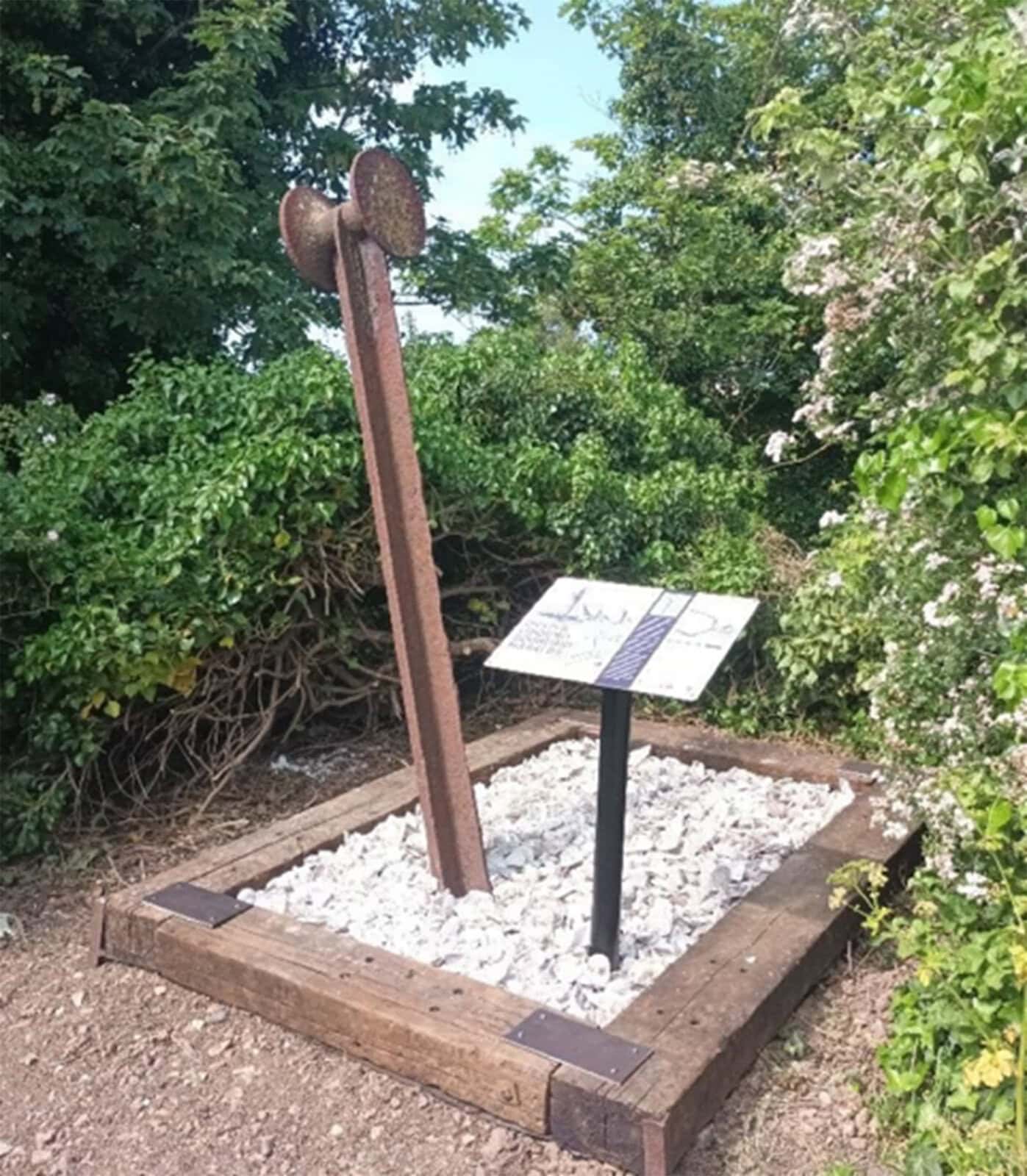
The old iron post, now leaning over, situated at the end of Island Wall, on the edge of the Village Green at Saxon Shore, has been in this position since its installation in 1865. It can be safely assumed that there was a marker beacon of some kind in this location long before this date.
This post functioned as the front marker (landmark) which could be lined up, by fishermen out at sea, with a back marker called the “Cross” (removed in the 1960’s) situated on higher ground just beyond the railway foot bridge at the end of West Cliff. This line, called a transit line, defined the boundary between the beds owned by the Company of Free Fishers and Dredgers of Whitstable and the Seasalter Oyster Fishery Company.
The Whitstable Improvement Trust assisted by Canterbury City Council, The Whitstable Oyster Company, The Whitstable Museum and Timescapes Kent considered it important to bring the existence of the last surviving oyster bed boundary marker to the attention of the public by recently making it more visible and installing two information boards to explain its significance.
It was one thing to mark out the territory, it was another to police it, especially at night. So the oyster companies employed ‘watchboats’ to guard their oyster beds. These were usually vessels too old for work and the crew were paid a bonus for being on duty overnight or at weekends.
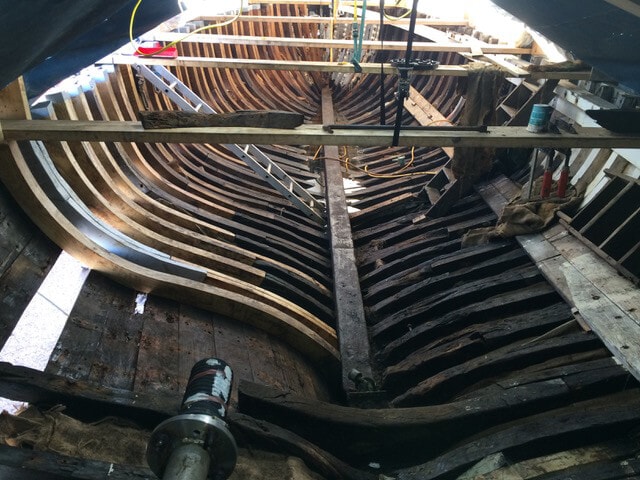
The sight and sound of Oyster Yawls being built on Island Wall is fast fading from the collective memory. Yet today in Whitstable Harbour you can see local Volunteers restoring a 42-foot Yawl built in 1906 and now registered as a National Historic Ship. Marine Surveyors predict that this iconic vessel will have a second working life of 60 to 80 years because of the high quality of workmanship.
The Yawl known as Gamecock was built by Collars Alley by the Collars Brothers and worked all her life in the Swale. Three generations of the family watched the Gamecock being lifted on to the East Quay where Whitstable Maritime has created a boat-building yard with the help of the Harbour Board and Bretts.
The current team of Volunteers is led by a master Shipwright trained by Alan Staley of Faversham, himself an apprentice of Anderson, Rigden & Perkins of Island Wall. The Charity is looking to have its own apprentice so that the traditional craft skills are retained in Whitstable.
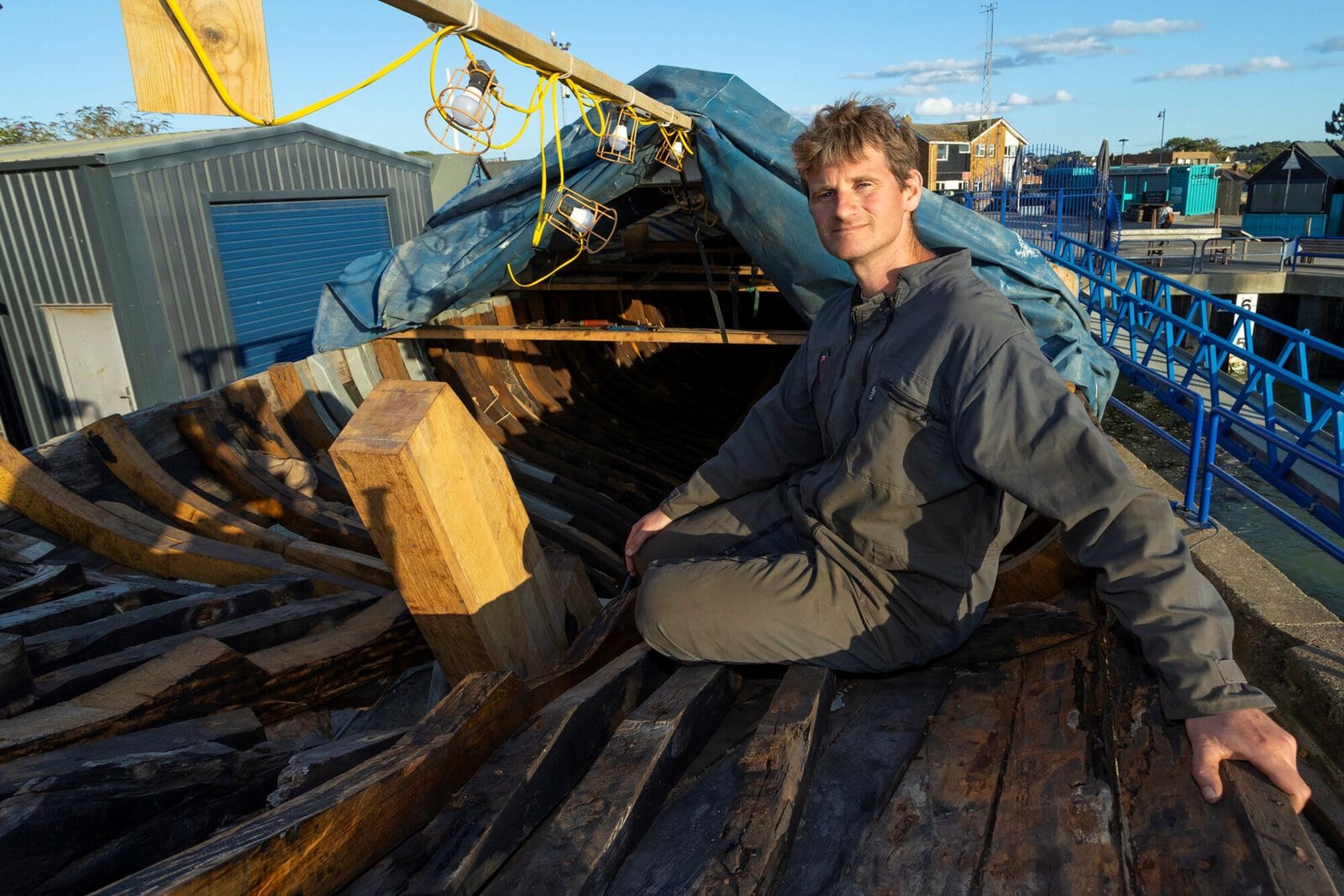
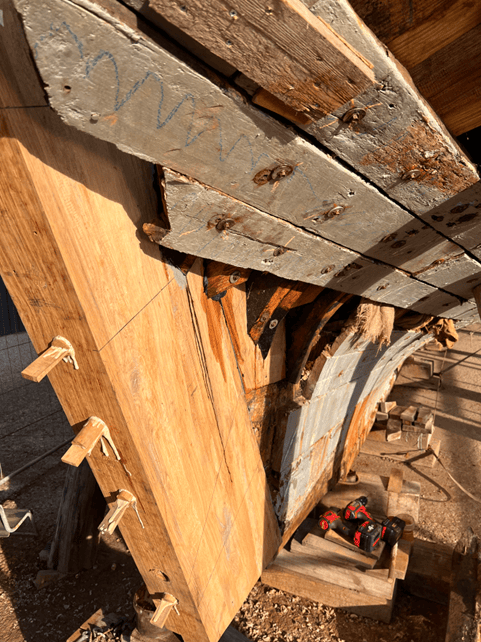
Morgan Lewis with Gamecock on the East Quay in 2013 by when the oak frame had been restored along the length of the hull. Approximately 30% of the original timber was able to be retained. Morgan gained his skills as a Shipwright with Alan Staley of Faversham who, in turn, was apprenticed to the last boat-builder on Island Wall. The protruding block of timber is the top of the new stern post built from laminated oak.
The stern post is fixed to the bottom of the hull by 4 trunnels (long wooden pegs) and modern glues. The trunnels are made by the Volunteers from pieces of oak left after the curved frames had been cut. So waste is kept to a minimum. This traditional technique gives a very strong fixture and avoids the use of metal bolts which can corrode in sea-water over time.
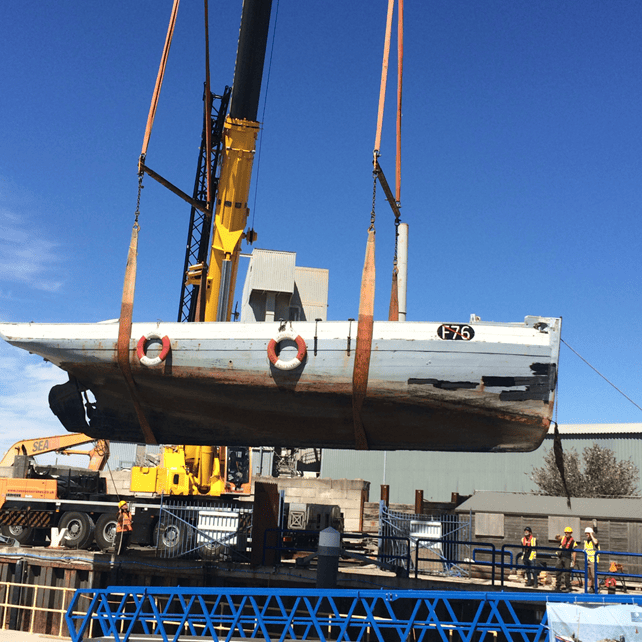
Gamecock being craned out of the water on to Whitstable Maritime’s temporary ‘boatyard’ on the East Quay of the Harbour prior to restoration. Although 43-feet long, the sleek lines of the hull help her sail well in a light wind. The counter-stern (over-hanging deck at the rear) increases the work platform and is a distinguishing feature of a Whitstable Oyster Yawl.
Faversham boat-owners were used to seeing the Gamecock moored at the mouth of the Oare. She was one of over 70 Whitstable Oyster Yawls that worked in the Swale.
Thanks to Whitstable Maritime, this rare craft has been saved from a watery grave and is being fully restored in Whitstable Harbour by local Volunteers. You can help thousands of local folk enjoy sailing her by donating on this website.
Cookie permissions
This site uses only functional cookies – small text files that are placed on your machine that enable this website to function properly.
In general, these cookies are used to retain user preferences, store information for things like shopping carts, and prevent spam. This site does not use cookies for tracking data.
Functional
Always active
The technical storage or access is strictly necessary for the legitimate purpose of enabling the use of a specific service explicitly requested by the subscriber or user, or for the sole purpose of carrying out the transmission of a communication over an electronic communications network.
Preferences
The technical storage or access is necessary for the legitimate purpose of storing preferences that are not requested by the subscriber or user.
Statistics
The technical storage or access that is used exclusively for statistical purposes.The technical storage or access that is used exclusively for anonymous statistical purposes. Without a subpoena, voluntary compliance on the part of your Internet Service Provider, or additional records from a third party, information stored or retrieved for this purpose alone cannot usually be used to identify you.
Marketing
The technical storage or access is required to create user profiles to send advertising, or to track the user on a website or across several websites for similar marketing purposes.