Tag: Restoration

  • Pride in Place

    Pride in Place

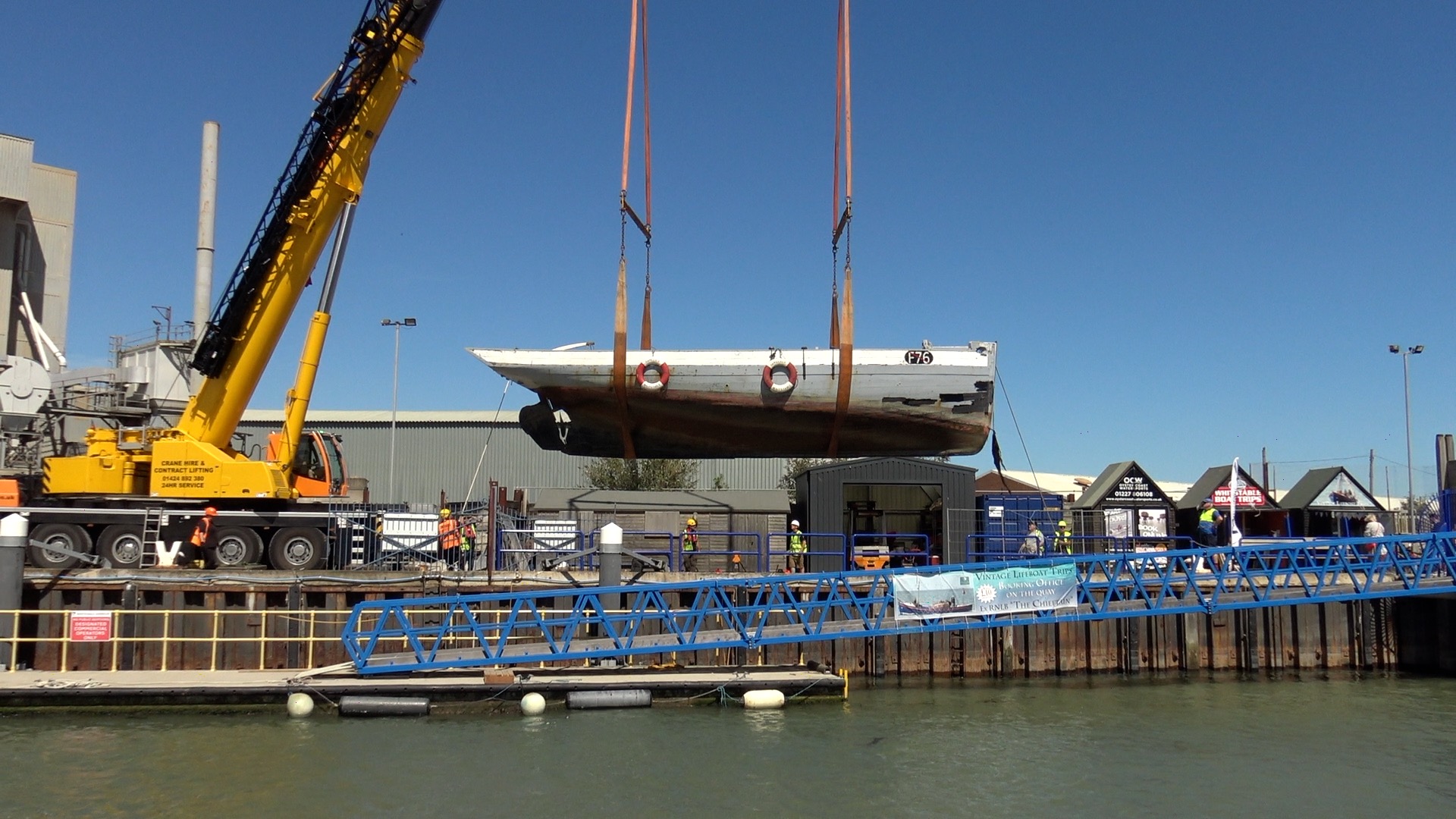
    Whitstable Maritime has been awarded a ‘Pride in Place’ Grant in support of the Gamecock’s restoration.   

    Canterbury City Council (CCC) is the local lead authority for the UK Shared Prosperity Fund which is a central pillar of the UK government’s Levelling Up agenda and provides £2.6 billion of funding for local investment by March 2025.  The Fund aims to improve pride in place and increase life changes across the UK investing in communities and places, supporting local business, and people and skills.  For more information, visit https://www.gov.uk/government/publications/uk-shared-prosperity-fund-prospectus

    Whilst the fundamental restoration work has been completed, funding is now required for the next stage of Gamecock’s restoration journey:

    • restoring deck-beams and replacing the hull planking;
    • production and strength testing of trunnels (tree nails);
    • developing the Maritime Curriculum including a training programme tailored to the Oyster Yawl;
    • developing educational activities focused on the coast, eg marine conservation, local ecology, oysters and mans impact on the environment.

    Follow the restoration journey on www.whitstablemaritime.org.uk

    For more details, or to Volunteer, contact whitstablem@gmail.com

  • Gamecock Progress

    Gamecock Progress

    The first part of the first plank fitted.

    You can see the amount of twist in the plank. This meant it had to be steamed. Steaming makes the wood go ‘rubbery’ temporarily. It is then clamped into position and as it cools it hardens up again in the new shape.

    Watch this space for more planks being fitted…

  • Size Matters

    The typical Whitstable Oyster Yawl was between 40 and 45 foot in length. There were exceptions, for example the Rosa & ADA (F105) was 47 foot and Thyra was only 36 foot. For the yards along Island Way these were relatively small. Much larger craft were built on the slipways and then let down in to the sea at a time when there was no sea-wall.

    If you are interested in learning more about the larger vessels, then the Merchant Ships of Whitstable by Wallace Harvey (Emprint Publications, 1993) is a good source. 

    Some larger sailing ships registered as Whitstable built

    NAMEBUILDERBUILTTYPETONS
    BELMONTWhitstable Shipping Co.1895Schooner139t
    EQUIVALENTJames Daniels1847Schooner187t
    FANNY GANNThomas GannSchooner97t
    GRATITUDEWhitstable Shipping Co.1875Barquentine298t
    HANNAHWilliam Blackman1841Schooner113t
    MARY ANN GANNThomas Gann1847Schooner177t
    NELLIE S.George Henry Gann1876Brigantine282t
    SUNSHINEWhitstable Shipping Co.1890Ketch119t
    TANKERTON TOWERGoldfinch Bros.1884Schooner118t
    ZEBRINAWhitstable Shipping Co.1973Schooner156t
    Mary Ann Gann
  • Gamecock Structure

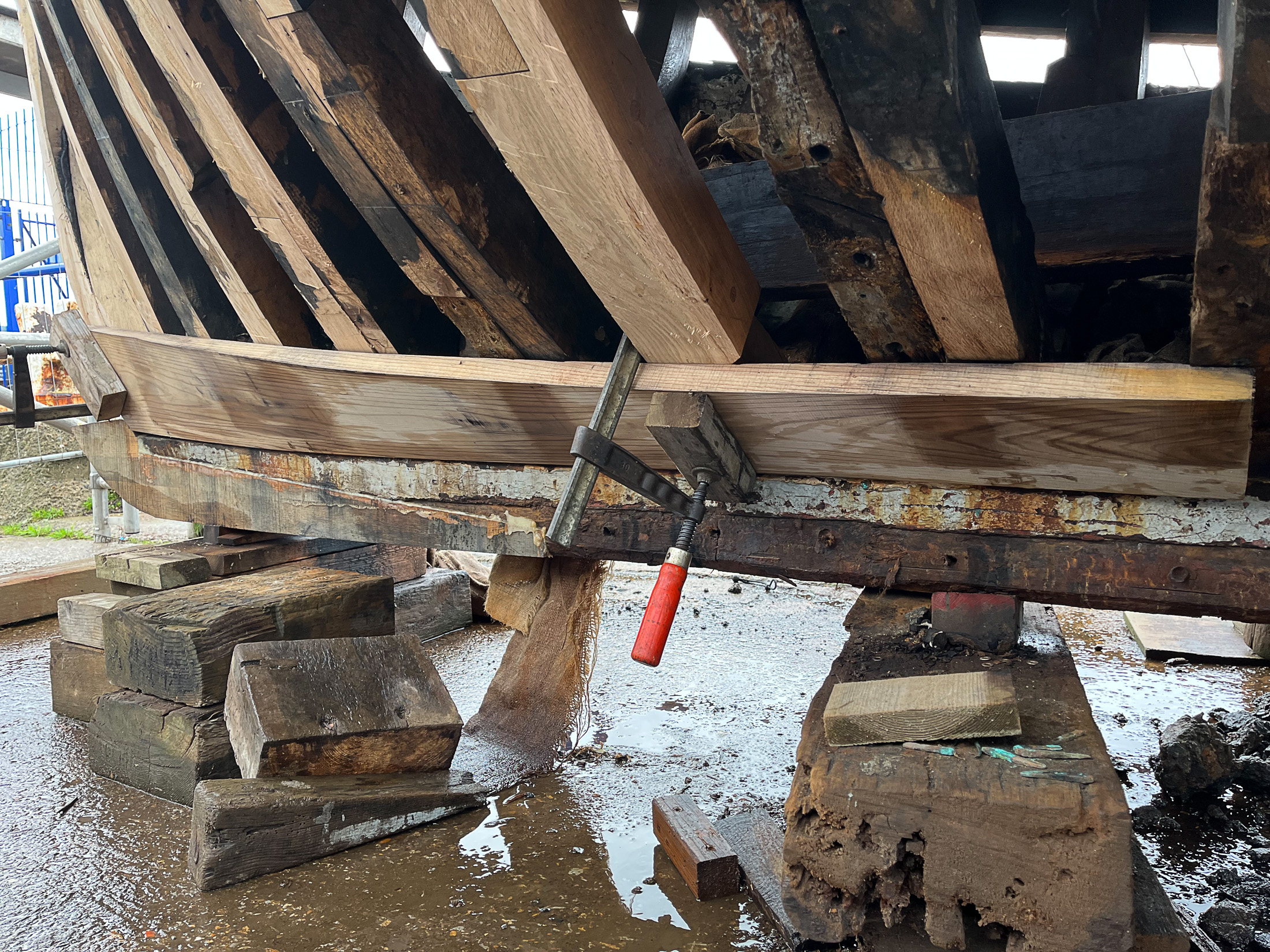
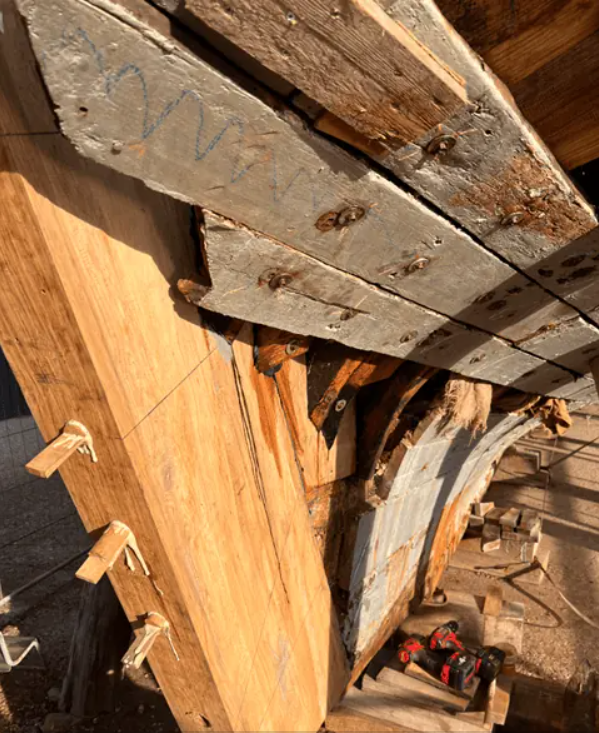
    Fundamental structural work has had to be undertaken … look at Gamecock’s skeleton.

  • Money, Yawls & Oysters

    Gamecock is one of the finest examples of her type, but why build a boat dedicated to a single purpose – the dredging of oysters? The answer is money.

    Gamecock is a graceful boat with curved lines running from bow to stern but her design is very functional. The hull is lacking in space because she rarely worked overnight. Her single keel was protected by a metal gutter to avoid damage on the hard sea bed. Most of the work was undertaken on the deck so it was extended to the rear by a counter-stern. Her design was the result of her function and working environment.

    Gamecock was not built until 1906/7 when there were still over 70 Whitstable Oyster Yawls in the fleet. In 1862/63 The Company of Free Fishers and Dredgers of Whitstable sent 60 million oysters to market at a value today of £91,000, equivalent to £11.5 million today. Not every year was as bountiful but Allan Collard, writing just before Gamecock was built, reckoned that the Whitstable Company annually sent 10 to 15 million oysters to market: (quoted by Derek Coombe in Fishermen from the Kentish Shore, published by Meresborough Books 1989).

    With such a precious product lying on the sea bed there was more than one company interested in dredging the Swale, not to mention possible poachers. The main competitors were The Faversham Oyster Co, The Ham & Sea Salter Co, and The Whitstable Oyster Company. To mark their respective territories the oystermen agreed ‘transit lines’. David Roberts, Chair of Whitstable Improvement Trust, has recently researched these navigation aids which he explains as follows.

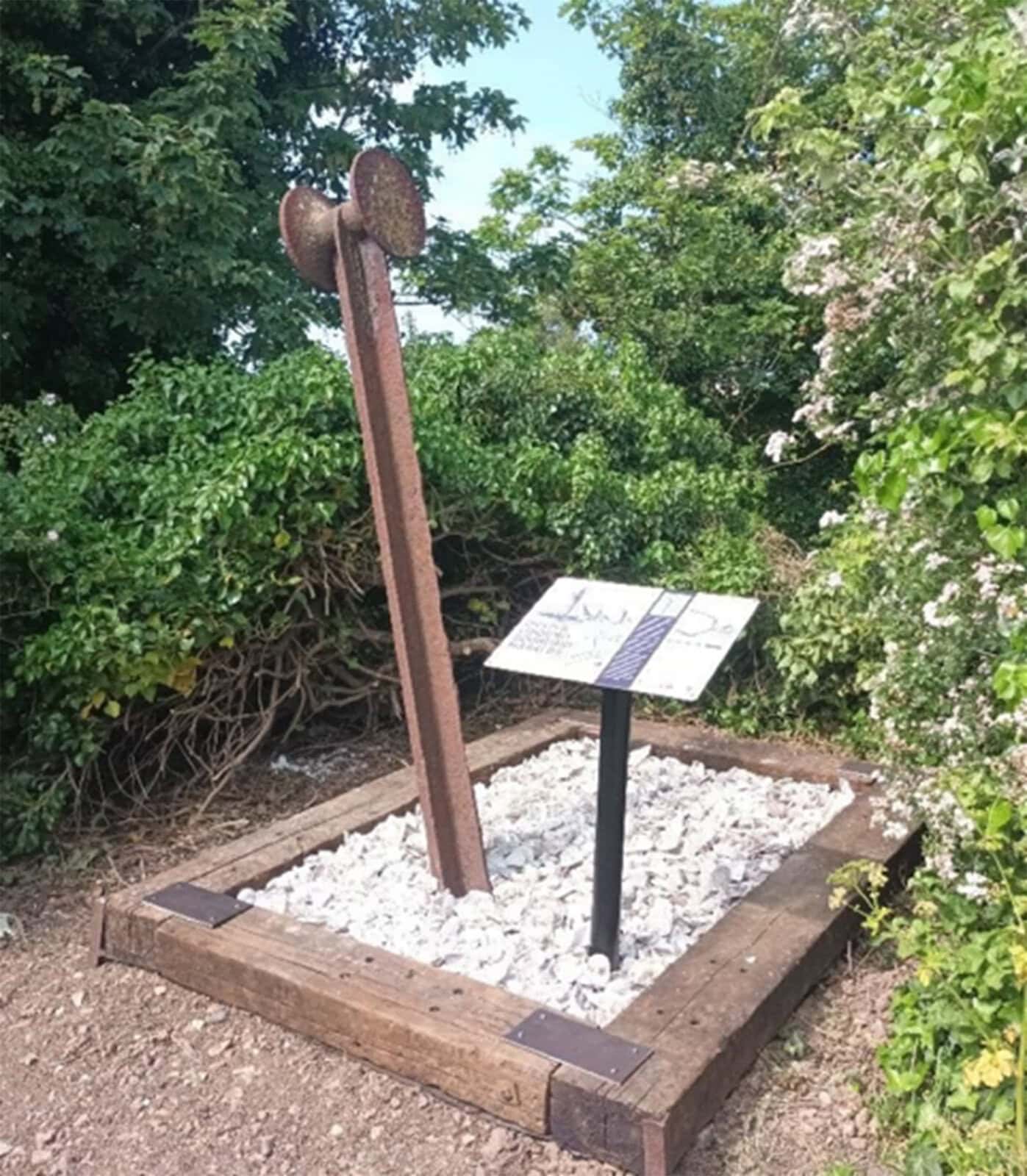
    The old iron post, now leaning over, situated at the end of Island Wall, on the edge of the Village Green at Saxon Shore, has been in this position since its installation in 1865. It can be safely assumed that there was a marker beacon of some kind in this location long before this date.

    This post functioned as the front marker (landmark) which could be lined up, by fishermen out at sea, with a back marker called the Cross” (removed in the 1960s) situated on higher ground just beyond the railway foot bridge at the end of West Cliff.  This line, called a transit line, defined the boundary between the beds owned by the Company of Free Fishers and Dredgers of Whitstable and the Seasalter Oyster Fishery Company.

    The Whitstable Improvement Trust assisted by Canterbury City Council, The Whitstable Oyster Company, The Whitstable Museum and Timescapes Kent considered it important to bring the existence of the last surviving oyster bed boundary marker to the attention of the public by recently making it more visible and installing two information boards to explain its significance. 

    It was one thing to mark out the territory, it was another to police it, especially at night. So the oyster companies employed ‘watchboats’ to guard their oyster beds. These were usually vessels too old for work and the crew were paid a bonus for being on duty overnight or at weekends.