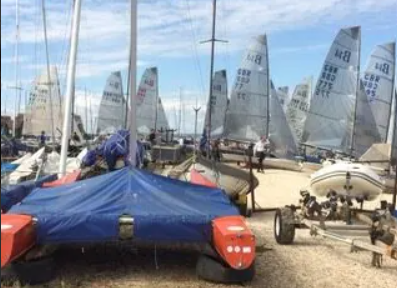
Planning is at an early stage but many organisations in Whitstable and the South-East are already developing ideas as to how they can best celebrate the town’s connections with the sea: past, present and future. The day will be packed with a full programme of activities for all ages, both on and off the water. Events will be held on both beaches and in the Harbour from 10.30am to 4.30pm, concluding with an evening concert on the South Quay.
How can you help create a successful Show?
Volunteer as a Steward and help welcome over 10,000 visitors. Alert the planning team to any group in the community who may have difficulty in accessing the Show for physical, mental or social reasons. Share news of the Show with colleagues and friends. Watch the local Press and Whitstable Maritime website for updates.
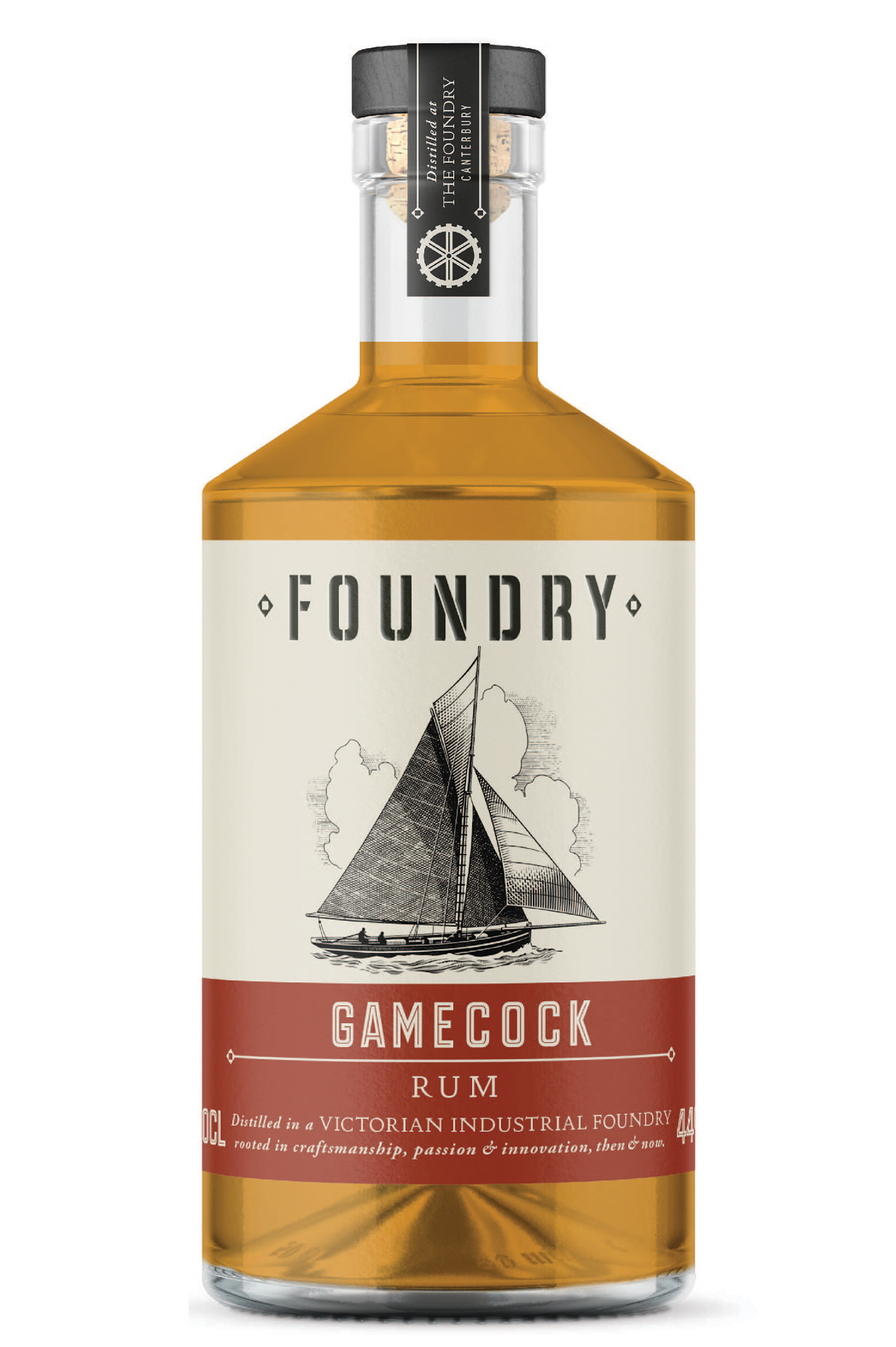
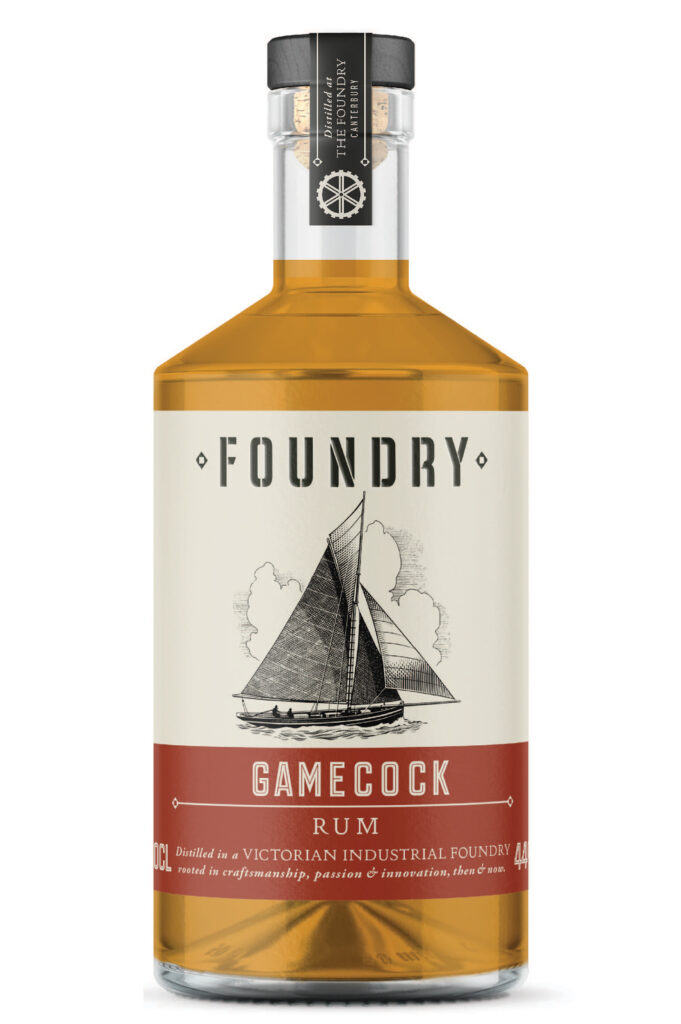
Help support the Gamecock restoration whilst enjoying the great taste of rum!
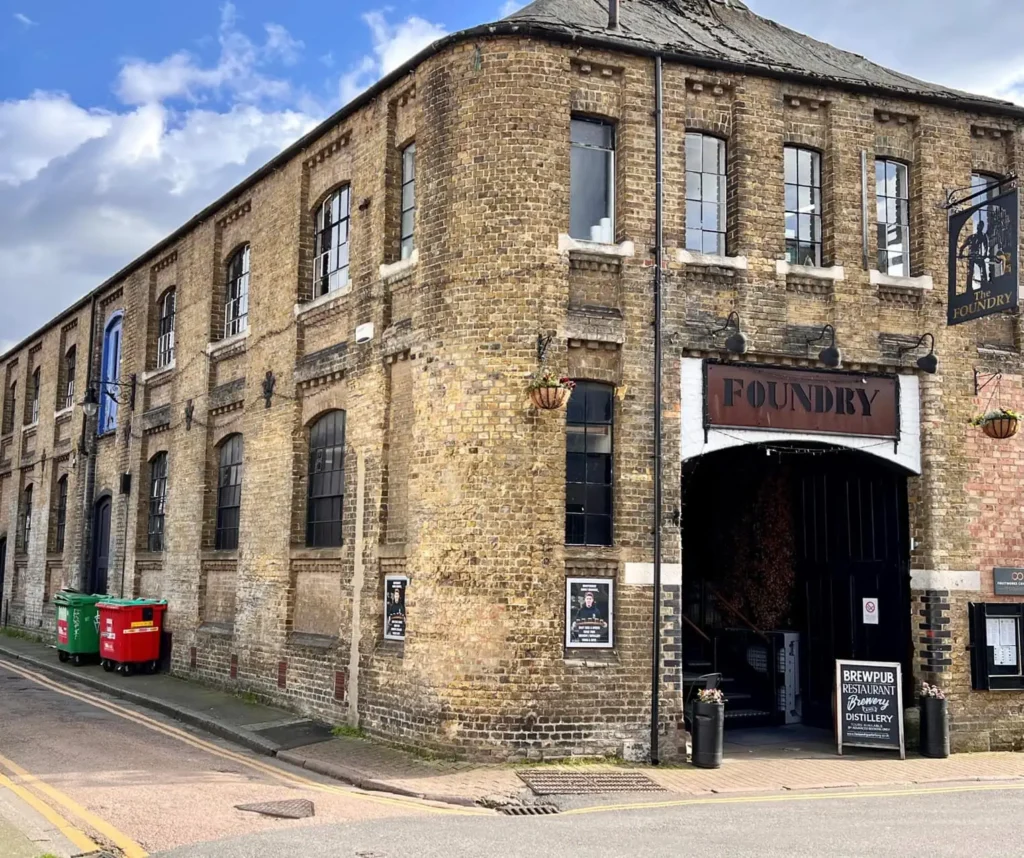
A dark rum produced by Canterbury Brewers & Distillers both celebrates and supports the restoration of the Whitstable Gamecock. This rum is initially aged in a first-fill Bourbon cask, then further aged in Virgin American Oak, and finally finished in a Virgin English Oak cask.
Supplied in a presentation box with a Gamecock Illustrated Glass, a portion of the proceeds goes directly to support the restoration work.
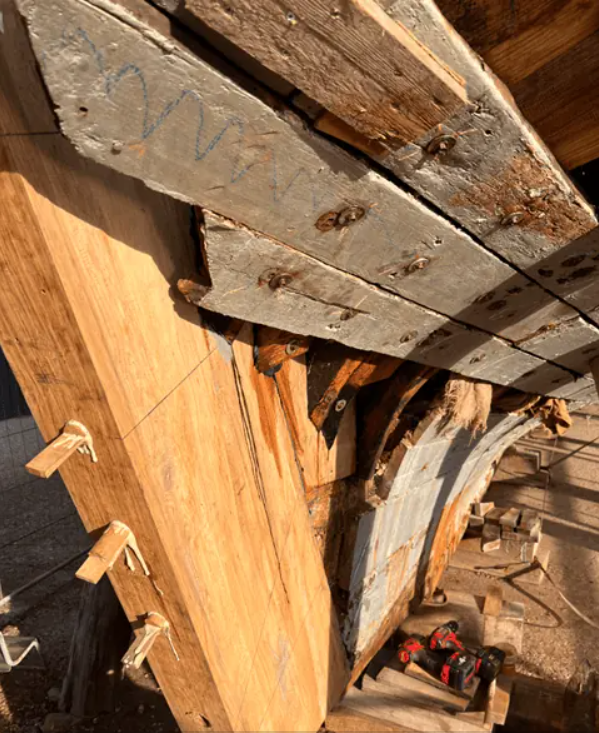
You are probably aware that we are using trunnels (wooden pegs and modern glues) on Gamecock rather than metal fixings, but do you know why? There are two good reasons, both relating to the environment.
Firstly, when cutting curved pieces of timber out of planks there is inevitably a high amount of waste: and Gamecock has a lot of curves! This is particularly distressing when the timber is rare and expensive hardwood. So there is an immediate benefit if we can cut the pegs out of the waste hardwood. The fixture is at least as strong as metal nuts and bolts. In a test on the East Quay the Volunteers had great fun using trunnels when moving their workshop, a large metal container full of tools.
Secondly, we are expecting the use of trunnels to extend the life of Gamecock beyond 60 years. The April 2024 edition of the American magazine ‘Wooden Boats’ has several articles expounding the benefits of trunnels following the capsize in 2017 of a 25 foot Nordic Folkboat built in 1951. When the craft was recovered it was clear that the metal keelbolts holding the one-ton cast-iron keel had come away and all of the ballast was now on the bed of a Norwegian fiord. Outwardly the keelbolts looked healthy but they had corroded to thin needles because of galvanic action and acidity in the oak.
Apparently as the metal corrodes it diffuses positive ions in to the water so that only electrons remain in the iron and they react with water and oxygen to produce rust. Stainless steel is less prone to this process but the more resistant forms are significantly more expensive and, off course, do not utilise the waste oak. The other consideration is corrosion of metal fixtures from the acidity released by wet, salty timber. Oak has a high level of acidity but even Douglas Fir, popular with boat-builders, can degrade metals. Our Volunteers spent over a Year extracting deeply embedded and corroded metal fixtures from timbers on Gamecock that we wished to retain.
When trunnels are used they need to be of a similar density to the wood they are fixing. If the trunnel is too dense then it is likely to split or distort the timber in to which it is being driven: if not dense enough then it is likely to come loose over time. So, in the case of the Gamecock the waste oak is ideal for fixing to the oak frames and fits well with our attempts to protect the environment.
Whitstable Maritime has been awarded a ‘Pride in Place’ Grant in support of the Gamecock’s restoration.
Canterbury City Council (CCC) is the local lead authority for the UK Shared Prosperity Fund which is a central pillar of the UK government’s Levelling Up agenda and provides £2.6 billion of funding for local investment by March 2025. The Fund aims to improve pride in place and increase life changes across the UK investing in communities and places, supporting local business, and people and skills. For more information, visit https://www.gov.uk/government/publications/uk-shared-prosperity-fund-prospectus
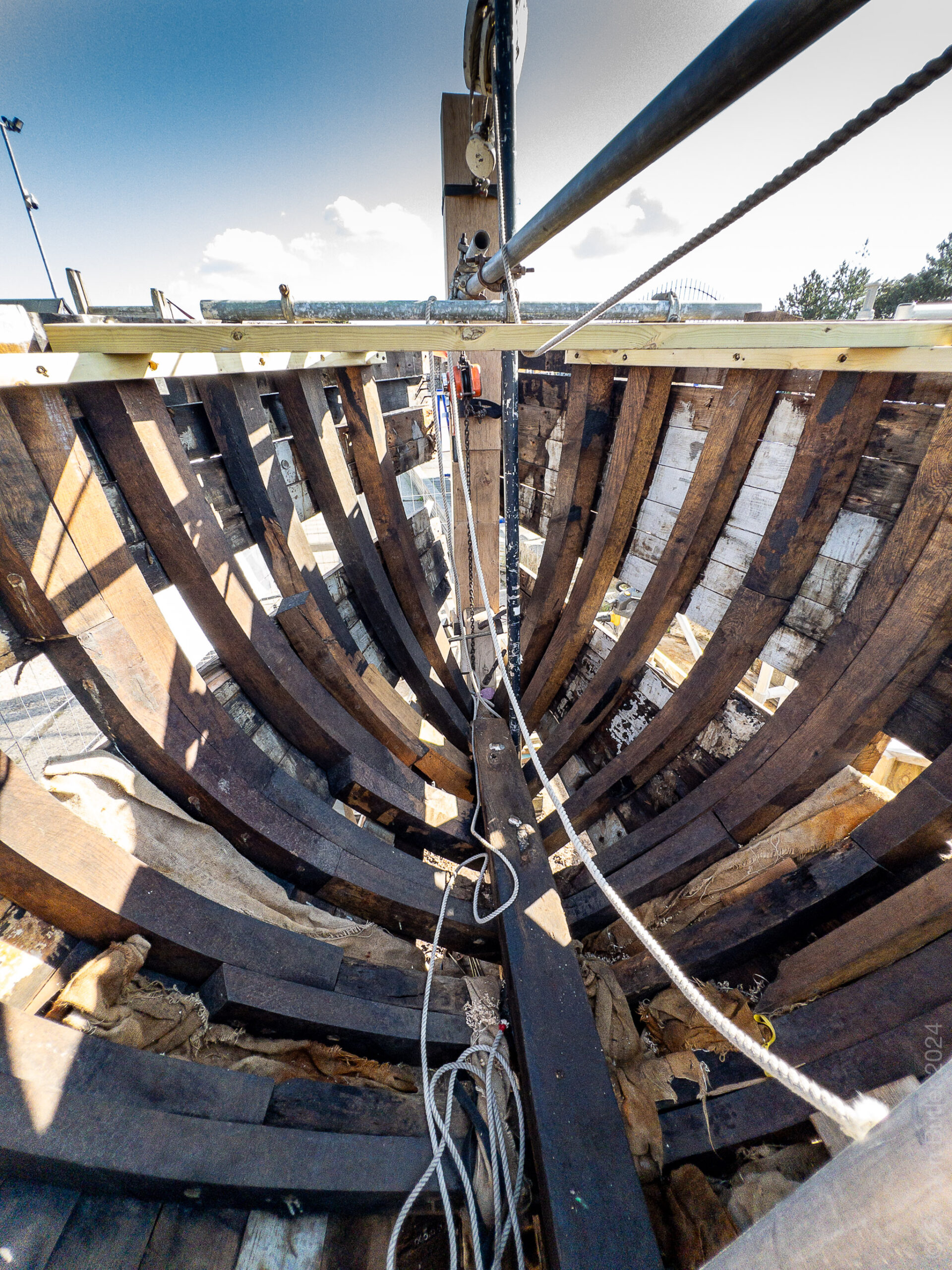
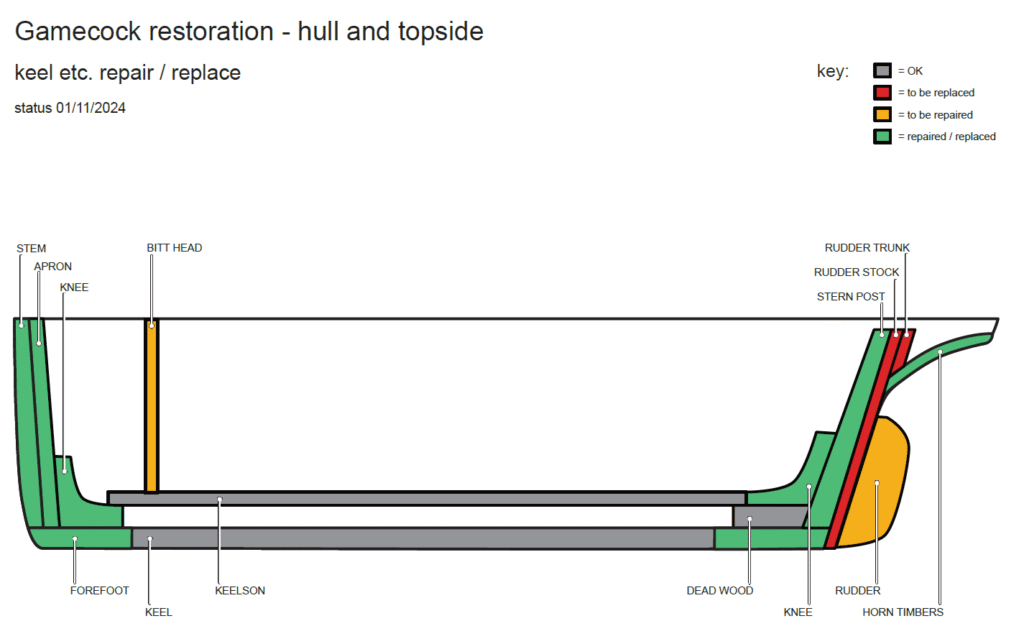
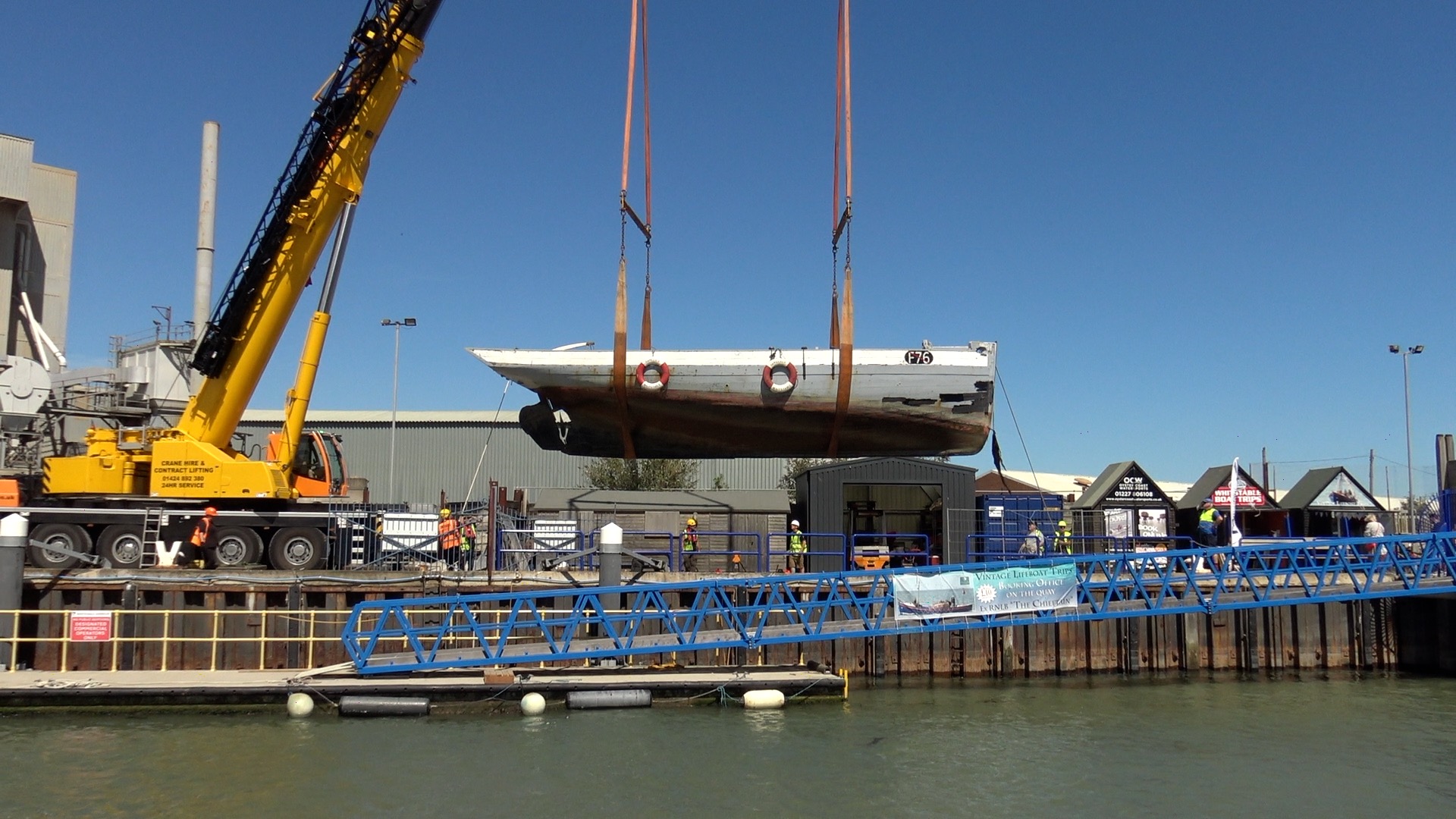
Whilst the fundamental restoration work has been completed, funding is now required for the next stage of Gamecock’s restoration journey:
restoring deck-beams and replacing the hull planking;
production and strength testing of trunnels (tree nails);
developing the Maritime Curriculum including a training programme tailored to the Oyster Yawl;
developing educational activities focused on the coast, eg marine conservation, local ecology, oysters and mans impact on the environment.
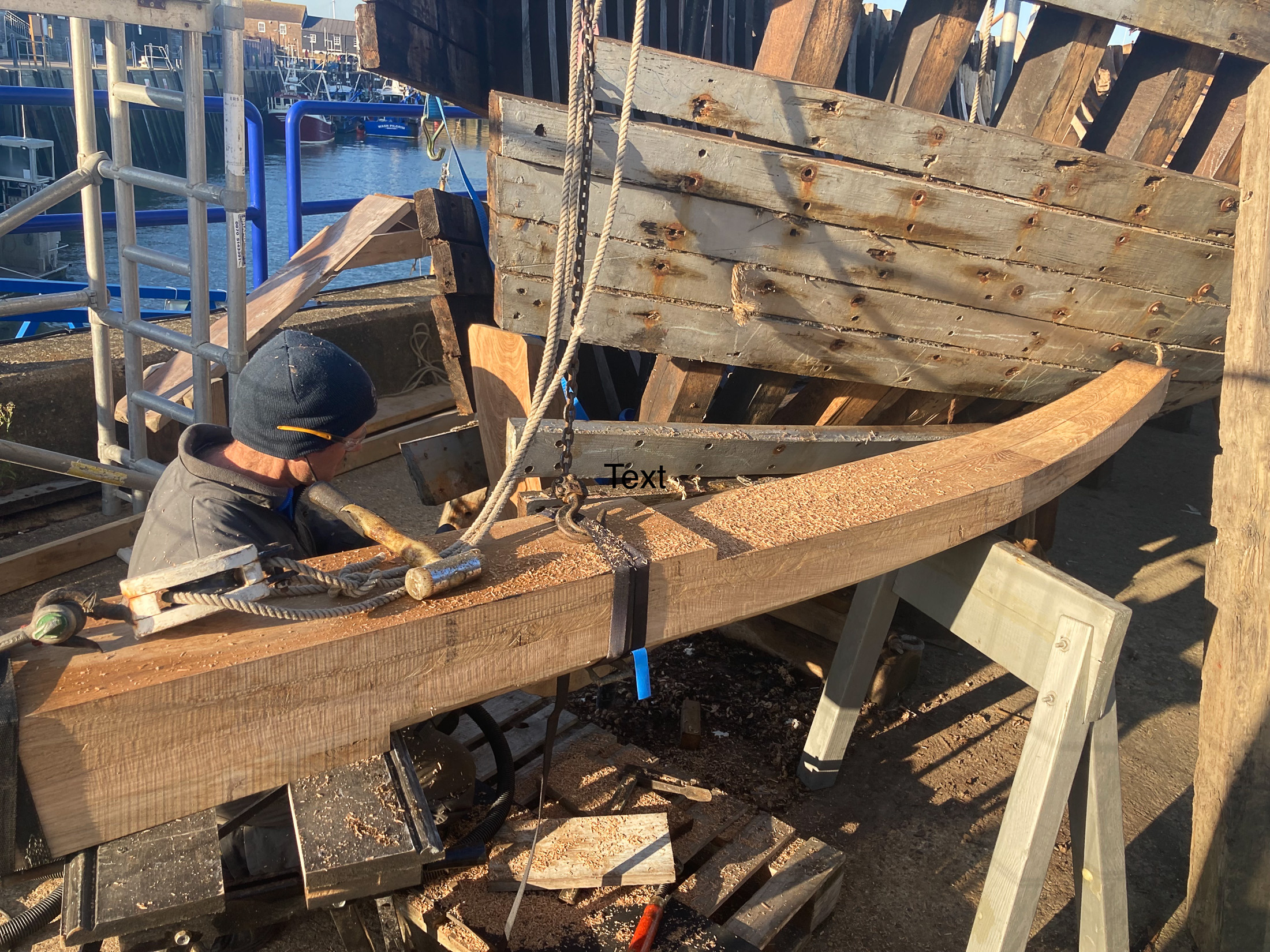
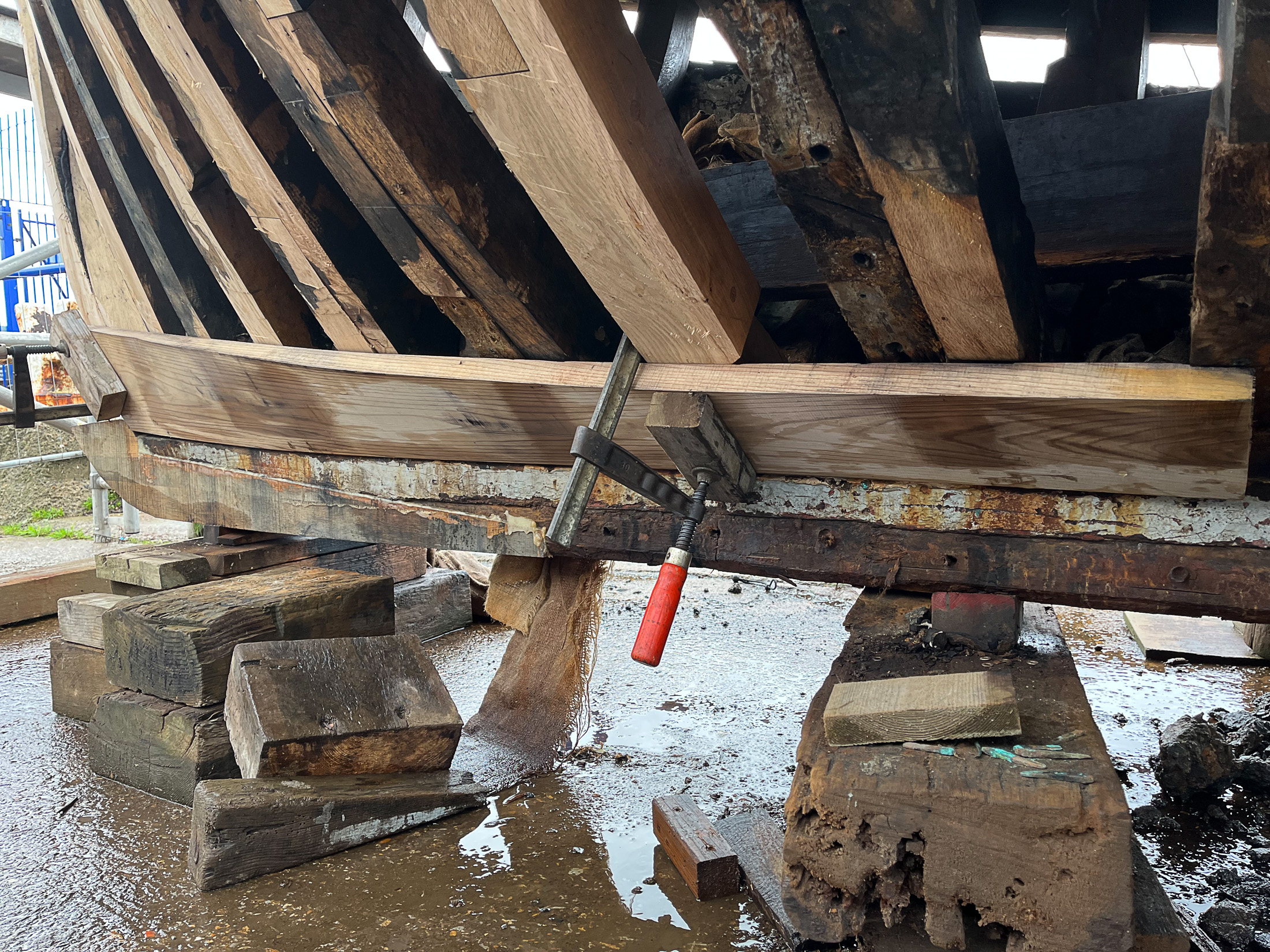
You can see the amount of twist in the plank. This meant it had to be steamed. Steaming makes the wood go ‘rubbery’ temporarily. It is then clamped into position and as it cools it hardens up again in the new shape.
The typical Whitstable Oyster Yawl was between 40 and 45 foot in length. There were exceptions, for example the Rosa & ADA (F105) was 47 foot and Thyra was only 36 foot. For the yards along Island Way these were relatively small. Much larger craft were built on the slipways and then let down in to the sea at a time when there was no sea-wall.
If you are interested in learning more about the larger vessels, then the Merchant Ships of Whitstable by Wallace Harvey (Emprint Publications, 1993) is a good source.
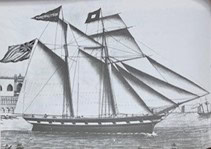
Some larger sailing ships registered as Whitstable built
Gamecock is one of the finest examples of her type, but why build a boat dedicated to a single purpose – the dredging of oysters? The answer is money.
Gamecock is a graceful boat with curved lines running from bow to stern but her design is very functional. The hull is lacking in space because she rarely worked overnight. Her single keel was protected by a metal gutter to avoid damage on the hard sea bed. Most of the work was undertaken on the deck so it was extended to the rear by a counter-stern. Her design was the result of her function and working environment.
Gamecock was not built until 1906/7 when there were still over 70 Whitstable Oyster Yawls in the fleet. In 1862/63 The Company of Free Fishers and Dredgers of Whitstable sent 60 million oysters to market at a value today of £91,000, equivalent to £11.5 million today. Not every year was as bountiful but Allan Collard, writing just before Gamecock was built, reckoned that the Whitstable Company annually sent 10 to 15 million oysters to market: (quoted by Derek Coombe in Fishermen from the Kentish Shore, published by Meresborough Books 1989).
With such a precious product lying on the sea bed there was more than one company interested in dredging the Swale, not to mention possible poachers. The main competitors were The Faversham Oyster Co, The Ham & Sea Salter Co, and The Whitstable Oyster Company. To mark their respective territories the oystermen agreed ‘transit lines’. David Roberts, Chair of Whitstable Improvement Trust, has recently researched these navigation aids which he explains as follows.
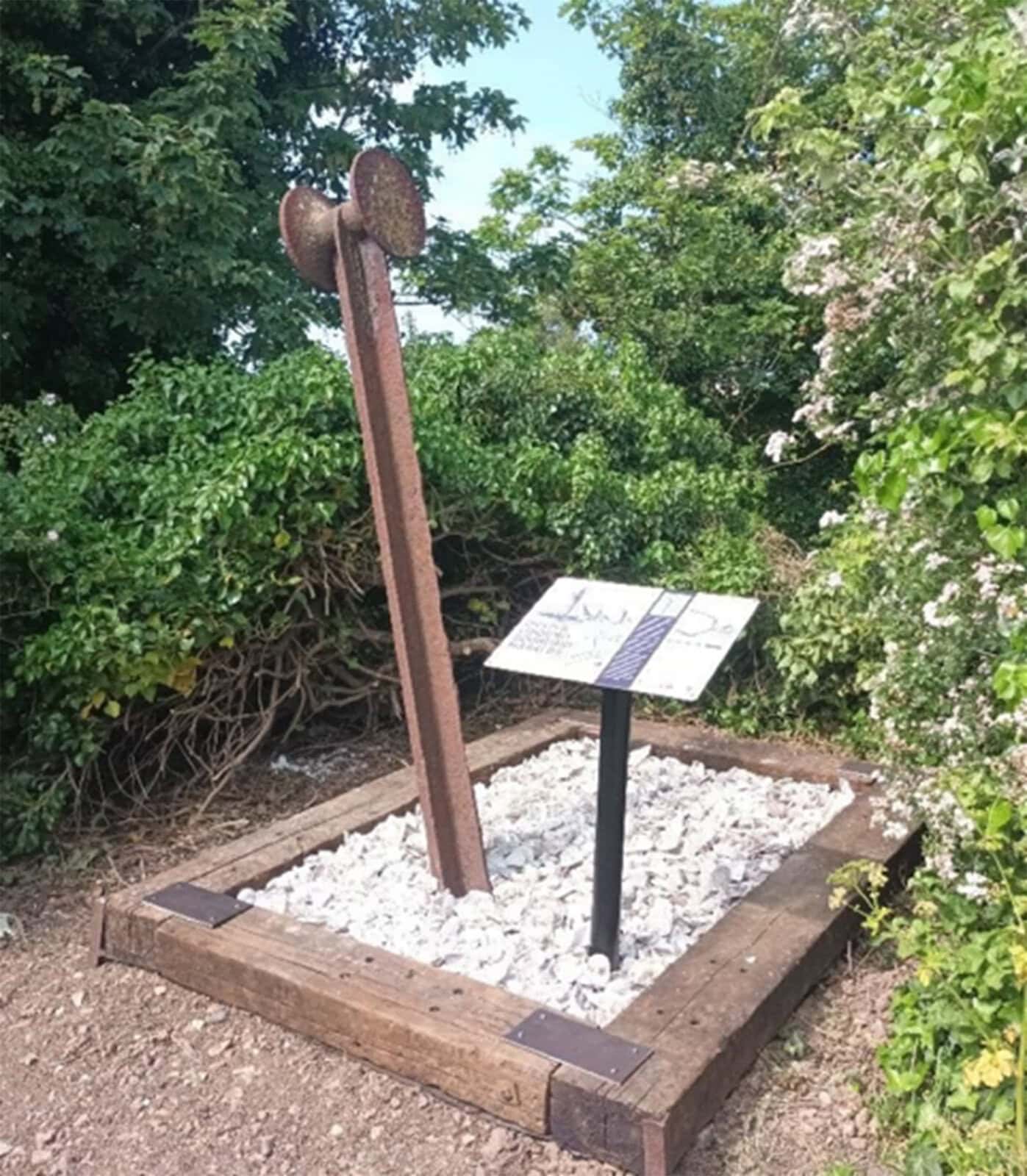
The old iron post, now leaning over, situated at the end of Island Wall, on the edge of the Village Green at Saxon Shore, has been in this position since its installation in 1865. It can be safely assumed that there was a marker beacon of some kind in this location long before this date.
This post functioned as the front marker (landmark) which could be lined up, by fishermen out at sea, with a back marker called the “Cross” (removed in the 1960’s) situated on higher ground just beyond the railway foot bridge at the end of West Cliff. This line, called a transit line, defined the boundary between the beds owned by the Company of Free Fishers and Dredgers of Whitstable and the Seasalter Oyster Fishery Company.
The Whitstable Improvement Trust assisted by Canterbury City Council, The Whitstable Oyster Company, The Whitstable Museum and Timescapes Kent considered it important to bring the existence of the last surviving oyster bed boundary marker to the attention of the public by recently making it more visible and installing two information boards to explain its significance.
It was one thing to mark out the territory, it was another to police it, especially at night. So the oyster companies employed ‘watchboats’ to guard their oyster beds. These were usually vessels too old for work and the crew were paid a bonus for being on duty overnight or at weekends.
Cookie permissions
This site uses only functional cookies – small text files that are placed on your machine that enable this website to function properly.
In general, these cookies are used to retain user preferences, store information for things like shopping carts, and prevent spam. This site does not use cookies for tracking data.
Functional
Always active
The technical storage or access is strictly necessary for the legitimate purpose of enabling the use of a specific service explicitly requested by the subscriber or user, or for the sole purpose of carrying out the transmission of a communication over an electronic communications network.
Preferences
The technical storage or access is necessary for the legitimate purpose of storing preferences that are not requested by the subscriber or user.
Statistics
The technical storage or access that is used exclusively for statistical purposes.The technical storage or access that is used exclusively for anonymous statistical purposes. Without a subpoena, voluntary compliance on the part of your Internet Service Provider, or additional records from a third party, information stored or retrieved for this purpose alone cannot usually be used to identify you.
Marketing
The technical storage or access is required to create user profiles to send advertising, or to track the user on a website or across several websites for similar marketing purposes.